When the Body Becomes the Practice: Listening Through Intentional Movement
A practical guide to using movement, breath, and body awareness as everyday tools for self-trust, regulation, and care.
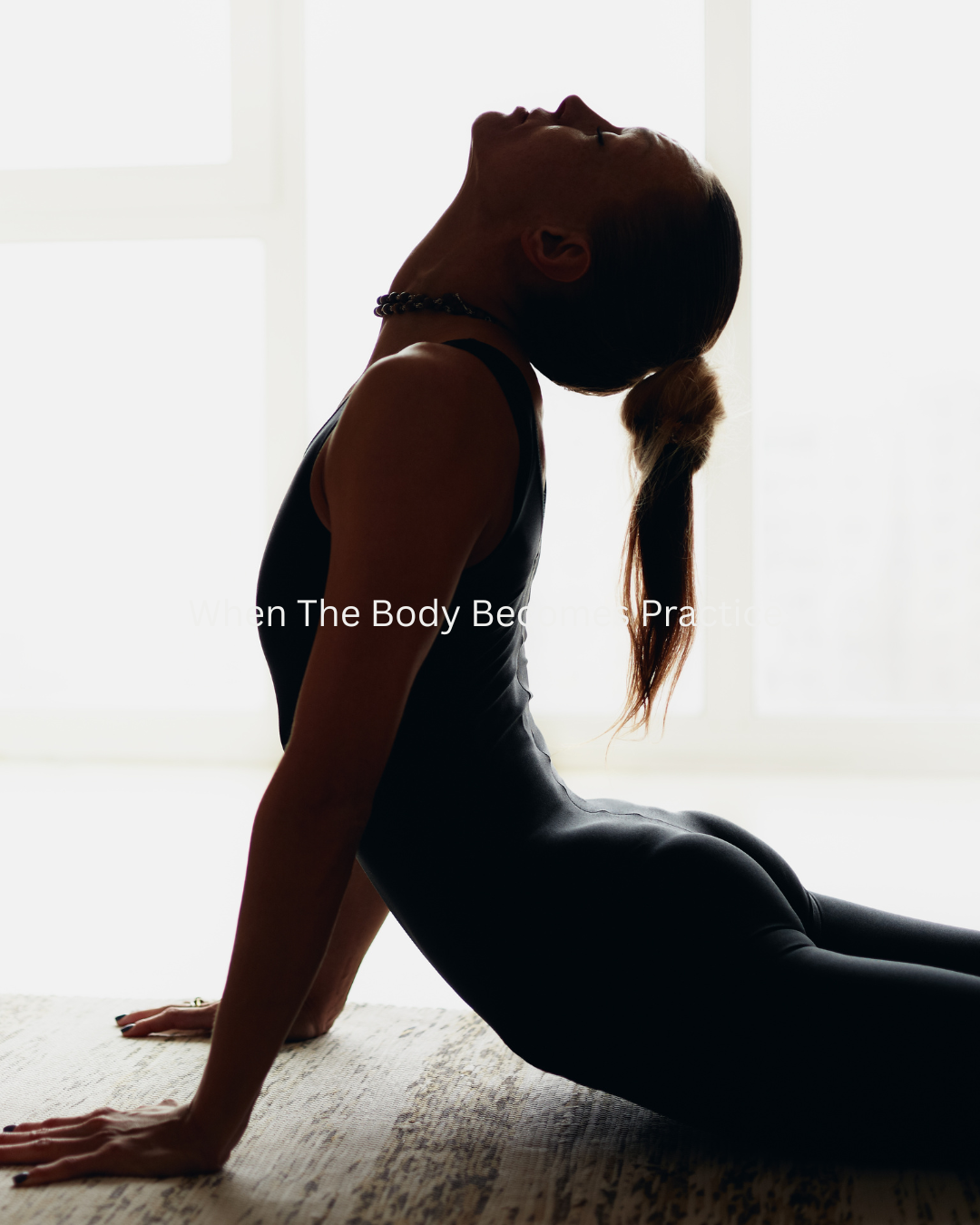
The body is not simply the vehicle carrying us through work, relationships, responsibility, and daily life. It is also a source of information.
It speaks before we have words.
It tightens, braces, slows, speeds up, aches, protects, pulls inward, reaches outward, and sometimes refuses to keep pretending everything is fine. Long before we say, “I’m overwhelmed,” “I’m exhausted,” or “I can’t keep going like this,” the body may already be whispering.
The question is not only whether the body is speaking.
The deeper question is: How do we learn to listen before the signal has to get louder?
For many of us, the body becomes something we manage only when it interrupts us: when pain appears, exhaustion takes over, anxiety spikes, or stress finally becomes impossible to ignore. But body awareness offers a gentler path. It teaches us to recognize the smaller signals—the held breath, the clenched jaw, the tired eyes, the restless hands, the heaviness in the chest—before they turn into louder demands for attention.
This kind of listening is not about diagnosing ourselves or getting every signal exactly right. It is about building a steady relationship with the body so that sensation becomes information, not something to fear or override.
Why Body Awareness Matters
Movement as a Practice of Listening
This is where intentional movement can become more than exercise.
Practices like yoga, tai chi, Pilates, walking, stretching, dance, breathwork, strength training, swimming, or other movement-based disciplines can offer a different kind of relationship with the body. Not one built only around performance, appearance, discipline, or productivity, but one built around attention.
Movement can become a place where we practice noticing.
In yoga, we may notice where we force ourselves into a shape before we have actually arrived. In tai chi, we may discover how difficult it is to move slowly when the nervous system is used to rushing. In Pilates, we may become aware of the deep stabilizing muscles that have been quietly supporting us all along. In walking, we may notice the pace we default to, the breath we carry, or the thoughts that travel with us. In stretching, we may meet the difference between intensity and harm, challenge and strain, effort and force.
Each modality becomes a mirror.
Not because one practice is better than another, but because movement gives the body a language we can observe. It helps us catch subtle signals before they become emergencies. It lets us practice responding in real time: If I soften here, what changes? If I breathe before I push, what becomes possible? If I slow down, what do I finally notice? If I stop forcing, does my body begin to trust me?
Simple Ways to Practice Listening in Movement
A deeper relationship with the body does not require a complicated routine. It can begin with a few minutes of honest attention. The goal is not to perform movement perfectly, but to notice what is present and respond with care.
· Pause before you begin. Ask yourself: What do I notice in my body right now? Where do I feel ease? Where do I feel tension?
· Follow your breath for one minute. Notice whether it feels shallow, steady, rushed, held, or spacious. Let the breath inform the pace of your movement.
· Move slowly enough to feel. Try walking, stretching, or reaching at half your usual speed. Notice what changes when movement is not rushed.
· Check the difference between effort and force. Effort can feel engaged and alive; force often feels gripping, bracing, or urgent.
· End with one question. Ask: What did my body want me to know today?
Exercise Modalities as Feedback Tools
Every form of movement offers a different kind of feedback. Some practices reveal where we are tense or guarded. Others show us how our breath responds to effort, how quickly we recover, or how well we can stay present when intensity rises. The practice becomes less about choosing the “right” modality and more about noticing what each type of movement teaches us.
· Cardio: Running, cycling, rowing, hiking, brisk walking, dancing, and other cardiovascular practices can show us how we respond to intensity. Notice what happens to your breath, your thoughts, your pace, and your urge to push harder or back away. Cardio can be especially useful for learning the difference between healthy challenge and overexertion.
· Strength training: Lifting weights, resistance bands, bodyweight exercises, and functional movement can reveal how we relate to effort, control, and rest. Notice whether you brace, hold your breath, rush through repetitions, or ignore fatigue cues.
· Yoga, Pilates, and mobility work: These practices often highlight alignment, stability, flexibility, and subtle compensation patterns. They can help us ask: Where am I gripping? Where am I collapsing? Where can I create more support?
· Walking and hiking: These accessible practices can provide feedback about pace, posture, breath, attention, and energy. A walk can become a moving check-in rather than just a way to get steps in.
· Dance and expressive movement: These modalities can reveal where we feel free, where we feel self-conscious, and how emotion moves through the body when there is room for expression instead of control.
· Swimming and water-based movement: Water can provide gentle resistance and support at the same time. It invites awareness of breath rhythm, buoyancy, coordination, and the feeling of being held while still moving.
Using the Cool-Down as a Check-In
The cool-down is often treated as an afterthought, but it can become one of the most valuable moments of the entire practice. After the body has moved, worked, heated, stretched, or strengthened, it is often easier to notice what changed. The cool-down gives the nervous system a chance to settle and gives us a natural opening to listen.
Instead of ending the workout the moment the hard part is over, the cool-down can become a bridge between movement and awareness. This is where you might notice how quickly your breath recovers after cardio, whether your shoulders soften after strength training, whether your mind feels clearer after a walk, or whether your body feels more available after stretching.
· Place one hand on your chest or belly and notice the rhythm of your breath.
· Ask: What feels different now than before I began?
· Notice whether your body feels energized, depleted, grounded, restless, open, or guarded.
· Scan for areas that softened and areas that still feel tense.
· Ask whether the intensity you chose felt supportive or too much for today.
· Let the final few minutes be less about performance and more about integration.
Reflection Prompts for After Movement
If you journal, teach, coach, or simply want to deepen your own practice, these questions can help turn movement into insight:
· Where did I feel most connected to my body today?
· Where did I notice myself pushing past what felt supportive?
· What sensation did I want to avoid, and what happened when I stayed curious instead?
· What pace felt honest for me today?
· What would it look like to carry this awareness into the rest of my day?
Taking the Practice Off the Mat
This is the next layer of care. We are not only asking, “What is my body telling me when I am overwhelmed?” We are also asking, “How can I build a relationship with my body before overwhelm becomes the only time I pay attention?”
Intentional movement invites us to listen when nothing is wrong yet.
And that may be one of the most powerful practices of all.
Final Takeaway
The body does not need to be pushed into wisdom. Often, it is already offering it. Intentional movement gives us a way to listen with patience, respond with compassion, and build trust before crisis demands our attention.
Try this today: Choose one simple movement—walking, stretching, breathing, reaching, or standing still—and let the question be less “Am I doing this right?” and more “What am I learning by paying attention?
At its heart, this practice is about returning to the body as a place of wisdom, not just a place of output. Body awareness helps us notice the subtle signals that often come before stress becomes overwhelming. Intentional movement gives those signals room to surface, whether through the rhythm of cardio, the focus of strength training, the steadiness of walking, the alignment of mobility work, the expression of dance, or the support of water-based movement.
The cool-down then becomes a meaningful pause—a moment to ask what changed, what softened, what still needs support, and what the body may be asking us to carry forward. In this way, movement becomes more than exercise. It becomes a conversation. And each time we choose to listen with curiosity instead of judgment, we strengthen the relationship between awareness, trust, and care.