Leadership Before Action
Reflections on ahimsa, capacity, and leadership in practice
In the yogic tradition, ahimsa—the principle of non‑harming—is often understood as an ethical commitment toward others. In practice, it runs deeper. Ahimsa is not only about what we do or say, but about the state from which we are acting.
In leadership contexts, this matters more than we often admit.
Every conversation, decision, or moment of pressure carries an energetic signature. People respond not just to the words we choose, but to the quality of presence we bring. When leaders ignore their internal state—pushing past limits, suppressing signals, overriding fatigue—the impact doesn’t stay internal. It transmits.
From a yogic lens, harm does not begin with behavior. It begins with disconnection from capacity.
Capacity Is an Ethical Consideration
In modern organizations, leaders are trained to manage time, priorities, and outcomes. Far less attention is given to managing energetic capacity—the internal resources that make clarity, empathy, and wise action available.
Ahimsa invites a different question before action:
What is my capacity in this moment—and what will be shaped by acting from here?
Capacity fluctuates continuously. When it is exceeded, even well‑intentioned leadership can become sharp, rushed, avoidant, or incoherent. When it is honored, leadership actions tend to be cleaner, more precise, and less emotionally costly—for everyone involved.
This is where micro recalibration becomes an applied leadership skill.
Micro Recalibration: Regulating Energy Before It Leaks
Micro recalibration refers to small, real‑time adjustments that integrate self‑regulation with ethical action. From a yogic perspective, it is the embodied practice of ahimsa—choosing responses that reduce harm by first stabilizing the system that is responding.
Not every moment requires the same level of engagement. Below are three common capacity states leaders’ cycle through, and how non‑harming can guide action in each.
Low Capacity: Containment as Leadership
(Overloaded, reactive, depleted)
When capacity is low, the nervous system is under strain. Decision‑making bandwidth narrows. Tone sharpens or collapses. In these moments, the highest risk is not inaction—it is unconscious transmission.
From an energetic perspective, leadership harm often looks like:
Responding too quickly
Escalating intensity
Forcing clarity before it’s available
Ahimsa here means containment.
Focus: Reducing energetic spillover.
Notice one internal signal (tightness, heat, urgency, shutdown).
Breath:
Inhale through the nose.
Exhale through the mouth, slow enough to feel a subtle settling.Delay response, even briefly.
Micro recalibration:
Pause • Breathe • Space
This is not disengagement. It is leadership discipline—knowing when not to act in order to prevent unnecessary harm.
Medium Capacity: Stabilization and Signal Clarity
(Present, but stretched)
At medium capacity, leaders have awareness but limited surplus. This is where many conversations occur—and where harm often becomes subtle rather than overt.
Energetically, this is the space where misalignment shows up as:
Over‑explaining
Taking on more than is sustainable
Losing clarity around boundaries
Ahimsa here asks for self‑honesty and pace regulation.
Focus: Stabilizing internal signal.
Name what is happening internally.
Breath:
Inhale naturally.
Exhale slightly longer than the inhale, softening jaw or shoulders.Ask one clarifying question.
Adjust pace, tone, or scope.
Micro recalibration:
Notice • Name • Adjust
When leaders regulate at this level, they preserve trust—internally and relationally—by not asking their system (or others) to compensate for unacknowledged strain.
Clear Capacity: Directed Action Without Force
(Grounded, coherent, resourced)
When capacity is clear, leaders can act with precision rather than urgency. This is where values translate cleanly into behavior.
From an energetic lens, this state is marked by:
Coherence between intention and impact
Stable presence
The ability to hold boundaries without aggression
Focus: Direction and integrity.
Sense what feels true in the body.
Breath:
Breathe steadily through the nose.
Feel the feet and the steadiness beneath action.Speak what is true.
Set or reinforce a boundary.
Micro recalibration:
Sense • Choose • Act
Here, ahimsa does not mean softness. It means clarity without excess force—action that does not require others (or self) to absorb unnecessary friction.
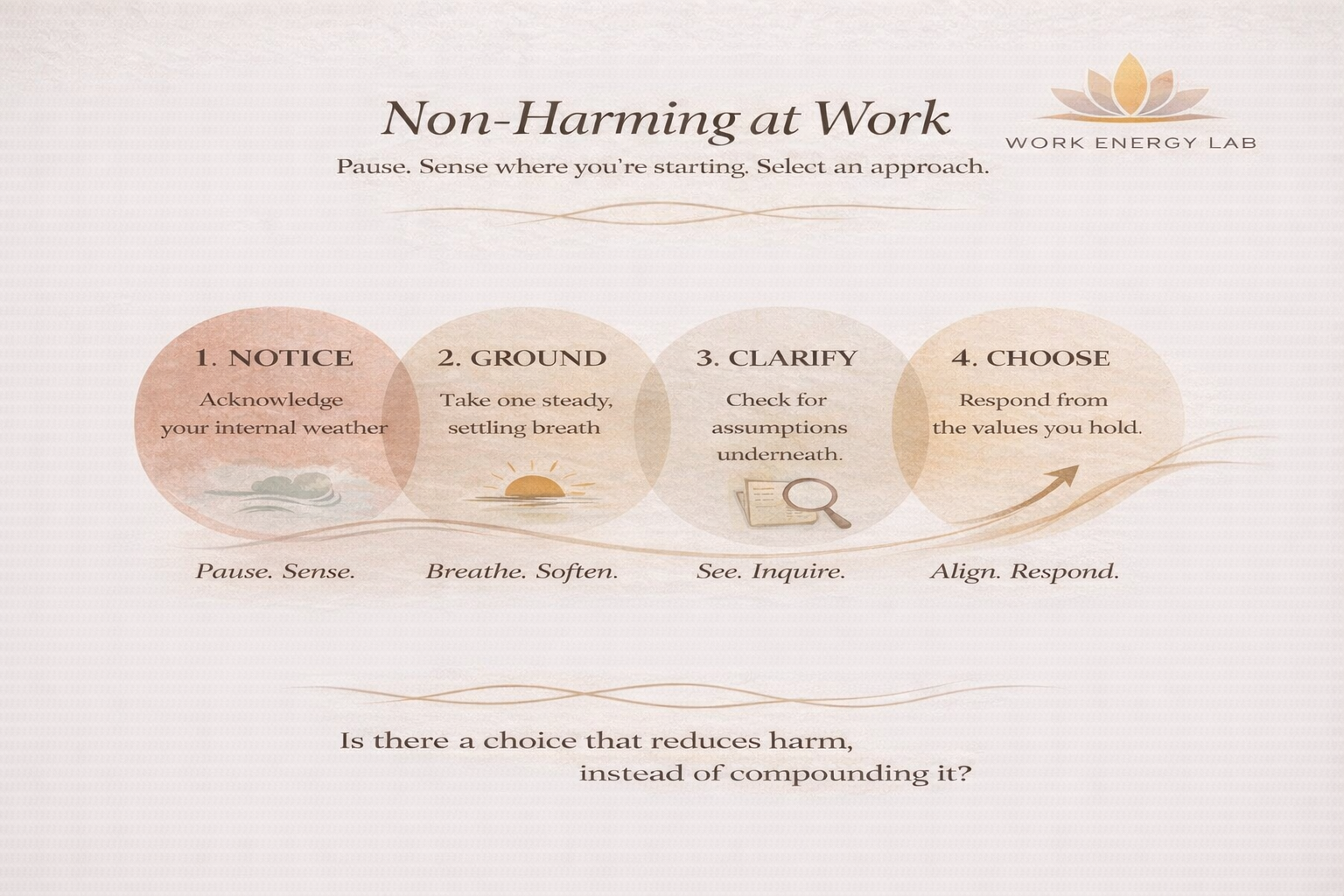
Ahimsa as Energetic Responsibility
From a yogic perspective, non‑harming is not an idealized trait. It is an ongoing practice of self‑contact and response choice. Leaders who attune to their capacity are not being self‑protective—they are being ethically precise.
When internal energy is attended to, leadership actions carry less distortion. When it is ignored, harm often appears not through intention, but through leakage.
Ahimsa, then, becomes not just a moral stance, but a discipline of energetic stewardship—meeting oneself honestly so others do not bear the cost of that disconnection.
Capacity will shift. This is not about mastery.
It is about locating oneself—and choosing from there.